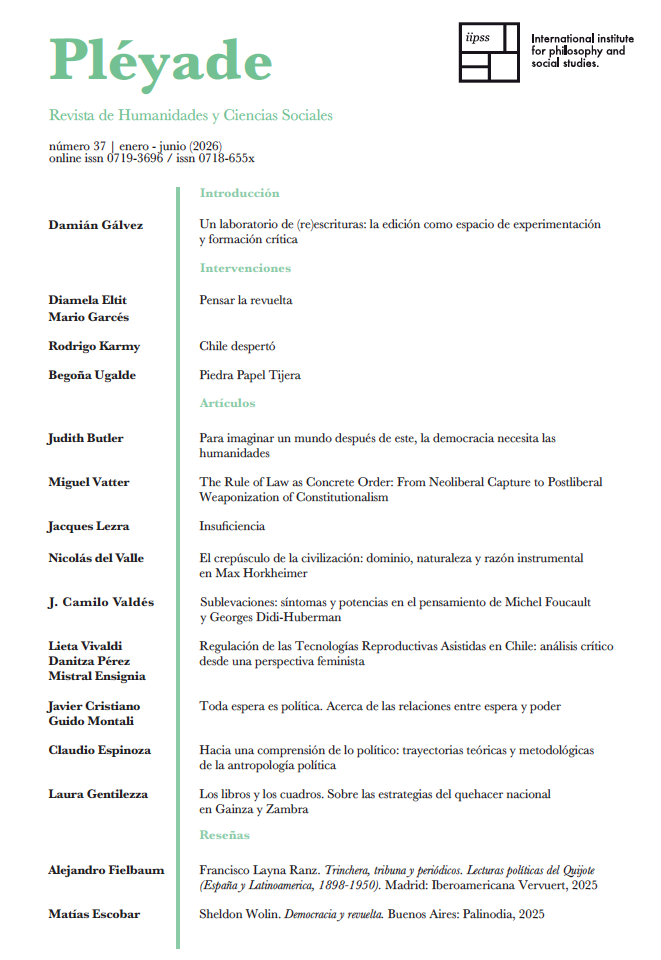
Toward an Understanding of the Political: Theoretical and Methodological Pathways in Political Anthropology
 Claudio Espinoza
Published 2026-07-31
Keywords
- Political anthropology,
- theory,
- method
How to Cite
Copyright (c) 2026 Claudio Espinoza

This work is licensed under a Creative Commons Attribution-NonCommercial 4.0 International License.
Abstract
This article examines the theoretical and methodological trajectories of political anthropology, analyzing “the political” as a constitutive dimension of social life. Through a chronological overview, it addresses the evolution of the discipline from its nineteenth-century precursors and the debate on the social contract to contemporary perspectives centered on power, resistance, and anthropological reflexivity. It analyzes the transition from structural-functionalism —which focused on order and segmentary systems— to a process-oriented approach that prioritizes conflict and social action. Furthermore, it integrates the contributions of neo-evolutionism and cultural ecology into the classification of political organizations. Finally, the text highlights the discipline’s ability to challenge Western universalist assumptions, identifying dynamics of domination and transformation in spheres that transcend formal institutions, such as kinship and religion.