Published 2025-12-31
Keywords
- Juan José Saer,
- biopolitics,
- animality,
- eating
How to Cite
Copyright (c) 2026 Ali Kulez

This work is licensed under a Creative Commons Attribution-NonCommercial 4.0 International License.
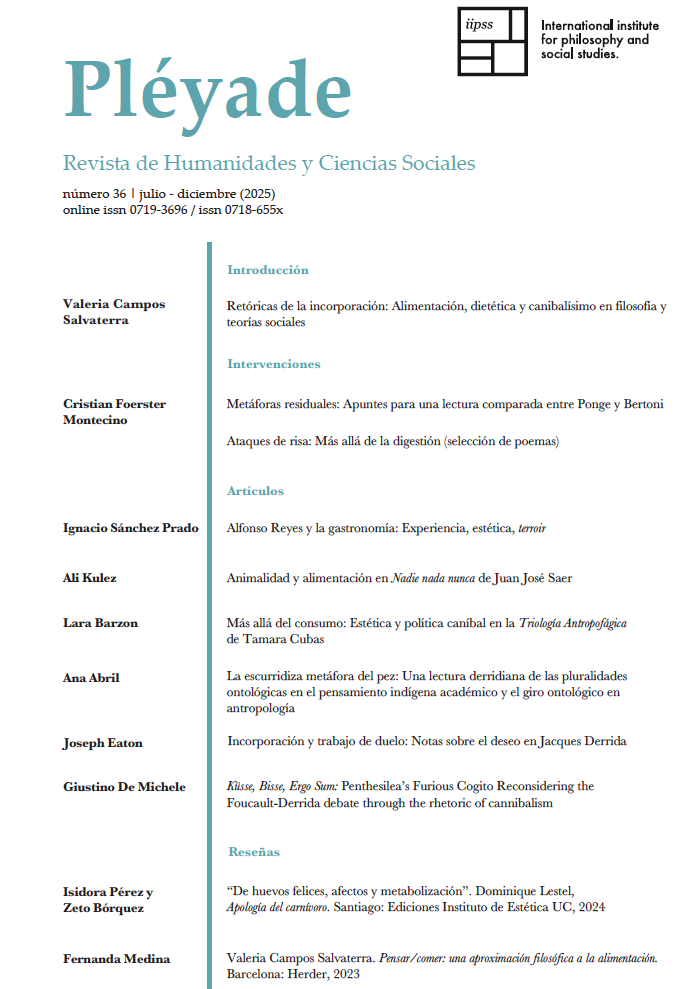
Abstract
Scenes of eating and drinking occupy a privileged place in the fiction of Juan José Saer from his earliest works: Responso (1964) captures the fleeting euphoria of an alcoholic over several glasses of beer; El limonero real (1974) addresses questions of mourning, memory, and isolation through a New Year’s Eve barbecue; and El entenado (1983), one of his best-known works, reimagines the story of a Spanish cabin boy captured by an Indigenous group that practices ritual cannibalism. This article examines the relationship between eating and animality in Nadie nada nunca (1980), a novel that includes multiple scenes in which characters eat silently in the presence of animals and experience unexpected becomings. The theme of eating—understood as a field of biopolitical interventions, as a problematization of the boundaries between the subject and the world, and ultimately as a reterritorialization of the mouth and an interruption of discourse—allows us to revisit Saer’s literary politics. The article argues that Saer’s narration defamiliarizes eating and invites us to think about it on infrahuman terms, in the interstices between human and animal, bios and zoe, inclusion and exclusion.